


Introduction: Building a Business That Does Not Depend on the Next Referral
One of the hardest parts of managing a small business is making operating and financial decisions when you don’t know where your next customer is coming from.
It becomes difficult to determine how many employees you need, whether you can afford another piece of equipment, or how much money you should maintain in your operating account. Even a profitable business can experience periods of financial difficulty when customer demand is inconsistent.
Many small-business owners attempt to address this problem by purchasing advertising, hiring a marketing company, improving their website, or subscribing to some type of lead generation service. Any of these activities may be useful, but purchasing marketing services is only one part of developing a marketing strategy.
In my earlier article, Why Small Businesses Need a Consistent Lead Generation Strategy, I discussed the importance of establishing a dependable process for attracting prospective customers. In this article, I want to take that discussion considerably further and explain how a business owner can develop and manage that process.
Effective small business marketing and lead generation require an understanding of the customers you want to acquire, what it costs to acquire them, how your business converts inquiries into sales, and whether your company has the financial and operational resources to service those customers profitably.
Generating additional inquiries may be exactly what your business needs. However, if your employees are already having difficulty responding to prospective customers, or if your business is losing money on the work it performs, additional marketing expenditures may make an existing problem worse.
The objective is to develop a customer acquisition system that you understand, can manage, can afford, and can increasingly depend upon when making other business decisions.
Table of Contents
- Understanding Small Business Marketing and Lead Generation
- Diagnosing Your Customer Acquisition Problem
- Identifying Your Ideal Customer and Competitive Position
- Understanding the Economics of Customer Acquisition
- Building a Small Business Customer Acquisition System
- Comparing the Major Marketing and Lead Generation Channels
- Choosing the Right Strategy for Your Stage of Business
- Establishing a Marketing Budget Your Business Can Support
- Building a Lead Management and Sales Conversion Process
- Using Marketing Technology, AI and Automation
- Deciding Whether to Hire a Marketing Agency
- Measuring Marketing Performance and Return on Investment
- Developing a 90-Day Marketing and Lead Generation Plan
- Knowing When to Expand, Modify or Discontinue a Marketing Strategy
- Frequently Asked Questions
- Marketing and Lead Generation Are Business Management Responsibilities
1. Understanding Small Business Marketing and Lead Generation
The Difference Between Marketing, Advertising, Lead Generation and Sales
Although these terms are frequently used interchangeably, they represent different business activities.
Marketing encompasses the activities involved in understanding a market, identifying prospective customers, establishing a competitive position, communicating customer value, and developing demand for a company’s products or services.
Advertising is one of the methods a business can use to communicate with prospective customers.
Lead generation involves identifying or attracting prospective customers who may have an interest in purchasing what the business provides.
Sales involves developing those opportunities into actual purchasing commitments.
Understanding these distinctions is useful when determining why a business is having difficulty acquiring customers. A company may have effective advertising that generates numerous inquiries but inadequate sales procedures. Another company may have competent salespeople who have very few opportunities because the business has not established sufficient market visibility.
Those are different management problems requiring different solutions.
Understanding the Customer’s Buying Journey
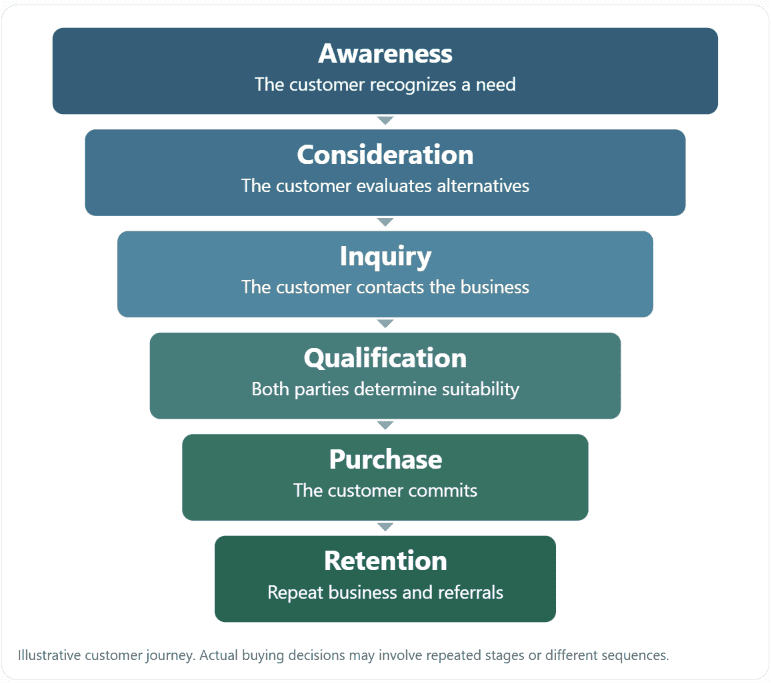
Customers generally go through several stages when making a purchasing decision. Understanding those stages helps a business determine what information and assistance prospective customers need.
| Customer stage | Customer activity | Business responsibility |
| Awareness | Becomes aware of a need or a business | Establish visibility |
| Consideration | Investigates possible solutions | Provide useful information and establish credibility |
| Inquiry | Contacts the business | Respond and obtain relevant information |
| Qualification | Determines whether the business can meet the requirement | Evaluate customer suitability and service requirements |
| Purchase | Makes a purchasing commitment | Establish clear terms and deliver on commitments |
| Retention | Evaluates the experience and considers future purchases | Maintain the customer relationship |
Customers do not always progress through these stages in an orderly sequence. A prospective customer may visit a website several times, obtain a recommendation from another business owner, and eventually contact the company months after first becoming aware of it.
Understanding the Different Types of Leads
A general inquiry may be nothing more than someone requesting information. A qualified prospective customer has characteristics that make a purchasing relationship reasonably possible.
A legitimate sales opportunity usually involves an identifiable purchasing requirement that the business has the ability to fulfill. An acquired customer has made an actual purchasing commitment.
Existing customers and referral-generated prospects should also be recognized separately. Their familiarity with the business may influence both the sales process and the cost of acquiring additional business.
Recording every inquiry as an equally valuable sales opportunity can give management a misleading impression of marketing performance.
Inbound Versus Outbound Marketing
Inbound marketing involves making the business visible and accessible to prospective customers who initiate contact. Search engines, educational content, referrals, and website inquiries are common examples.
Outbound marketing involves the business initiating communication with prospective customers through activities such as direct prospecting, professional networking, direct mail, or targeted outreach.
A residential plumbing company may benefit from being easily found when a homeowner has an immediate plumbing problem. A commercial maintenance company pursuing annual service contracts may benefit more from developing relationships with property managers before those contracts become available.
The customer’s purchasing process should have a considerable influence on the marketing method the business selects.
2. Diagnosing Your Customer Acquisition Problem
Before increasing marketing expenditures, I would encourage a business owner to determine what is currently happening to the customer opportunities the business receives.
Throughout this article, I will use a hypothetical commercial landscaping and property maintenance company to illustrate several of the management decisions involved.
| Business characteristic | Hypothetical assumption |
| Years in operation | 4 years |
| Annual revenue | $480,000 |
| Average monthly revenue | $40,000 |
| Primary customers | Commercial property owners and property managers |
| Existing marketing | Referrals, website, and occasional advertising |
| Monthly marketing expenditures | $1,500 |
| Average monthly inquiries | 30 |
| Qualified monthly inquiries | 15 |
| Average new customers acquired per month | 3 |
| Customer payment timing | Applicable invoices generally collected within 30–60 days |
| Principal challenge | Inconsistent customer acquisition |
These figures represent hypothetical averages, not an actual business or an assumption that the company’s monthly results are consistent.
The company is generating inquiries and acquiring customers. Before deciding that it needs additional advertising, management should investigate where improvements can be made within its existing customer acquisition process.
Is the Business Actually Generating Too Few Leads?
Insufficient inquiries may indicate inadequate market visibility. Prospective customers may have difficulty finding the business or may be unaware of the services it provides.
However, inquiry volume can also be influenced by market demand, competition, seasonal conditions, and customer purchasing cycles.
A commercial landscaping company may experience different purchasing activity during annual contract renewal periods than during other times of the year.
Management needs to determine whether additional prospective customers are available within its service market and whether its current marketing activities are reaching them.
Is the Business Attracting the Wrong Prospective Customers?
The hypothetical landscaping company receives an average of 30 inquiries each month, but only 15 qualify as suitable customer opportunities.
Its inquiry qualification rate is:
15 ÷ 30 × 100 = 50%.
The other inquiries might involve residential work the company does not perform, properties outside its service area, or jobs that are too small to justify dispatching a commercial maintenance crew.
Employees may still spend time answering calls, reviewing requests, and explaining why the company cannot provide the requested service.
Improving customer targeting could reduce that workload and increase the proportion of useful inquiries without requiring additional marketing expenditures.
Is the Business Failing to Convert Existing Opportunities?
Of the company’s 15 qualified monthly inquiries, an average of three become customers.
Its qualified inquiry conversion rate is:
3 ÷ 15 × 100 = 20%.
Its overall inquiry-to-customer conversion rate is:
3 ÷ 30 × 100 = 10%.
These percentages do not establish whether the company’s sales performance is good or poor. Management would need to understand the types of opportunities involved and why prospective customers did not proceed.
Estimates may be taking too long to prepare. Employees may not be following up on proposals. The company’s pricing may be unsuitable for its target market, or prospective customers may lack confidence in its ability to perform the work.
Additional advertising would not directly correct any of those problems.
Is the Business Losing Customers It Has Already Acquired?
Customer retention has a direct effect on the amount of new business a company must acquire.
If a commercial maintenance company loses several existing contracts each year, part of its marketing and sales effort must be devoted to replacing that revenue before the business can experience any meaningful growth.
Management should investigate customer complaints, service reliability, contract renewals, and the reasons customers discontinue their relationships with the business.
Customer Acquisition Problem Diagnostic Table
| Business symptom | Management investigation |
| Very few inquiries | Market demand, visibility, competition, and purchasing cycles |
| Numerous unsuitable inquiries | Customer targeting, service descriptions, geographic coverage, and offers |
| Website traffic without inquiries | Visitor suitability, website usability, credibility, and contact procedures |
| Numerous proposals but few accepted | Pricing, proposal quality, customer confidence, and follow-up |
| New customers but little repeat business | Service quality, customer satisfaction, and retention procedures |
| Increasing sales but declining cash balances | Margins, fulfillment expenses, payment timing, and working capital |
| More inquiries than employees can manage | Staffing, lead qualification, workload, and assigned responsibilities |
The value of this investigation is that it helps management direct its resources toward the part of the business that actually needs improvement.
3. Identifying Your Ideal Customer and Competitive Position
Defining the Customer Your Business Should Pursue
A business should have a reasonably clear understanding of the customers it is equipped to serve profitably.
Customer suitability involves more than whether someone needs the company’s services and is willing to purchase them. Geographic location, payment reliability, purchasing requirements, service expectations, contract size, and the demands placed on employees and equipment all affect the economics of the relationship.
For the hypothetical landscaping company, a commercial property requiring recurring maintenance within an established service route may be more attractive than a larger property located a considerable distance from its other customers.
The additional travel time, fuel expense, scheduling difficulties, and supervisory requirements associated with the distant property could reduce its profitability.
Management should use information from existing customer relationships to develop a practical customer profile. That profile should influence the company’s advertising, website content, prospecting activities, and lead qualification procedures.
Researching Customer Demand
Useful market research does not always require purchasing an expensive research report.
A business can learn a great deal by reviewing its existing customer records, previous estimates, lost proposals, customer complaints, and the services that generate its most profitable business.
Conversations with existing customers can help identify why they selected the company, what they value about its services, and what other requirements they may have.
Competitor websites, publicly available customer reviews, and local market information can also help management understand the alternatives available to prospective customers.
The purpose is to develop a better understanding of how customers make purchasing decisions and whether the business is offering something they are prepared to purchase at a profitable price.
Establishing a Meaningful Competitive Advantage
A competitive advantage must have some identifiable value to the customer.
Specialization, dependable scheduling, professional competence, responsiveness, convenience, and consistent service quality can all influence purchasing decisions.
A property manager responsible for several commercial properties may place considerable value on a landscaping company that provides reliable scheduling, communicates service problems promptly, and requires very little supervision.
The company may be able to compete effectively without submitting the lowest proposal.
However, simply describing the business as professional, reliable, and customer-oriented is not particularly persuasive if every competitor makes the same claims.
The company needs to demonstrate those characteristics through its operating procedures, customer communications, references, and actual service performance.
Developing an Effective Customer Offer
The service a company provides and the offer it uses to initiate a customer relationship are not always the same thing.
A commercial landscaping company provides maintenance services. Its initial customer offer might be a property assessment, a maintenance consultation, or a proposal developed around the property’s specific requirements.
The offer should give a suitable prospective customer a useful reason to contact the business.
Management should also consider the cost of providing that initial service. Free inspections or consultations can become expensive when employees spend a significant amount of time assisting people who are unlikely to become customers.
An effective offer attracts prospective customers the business wants to serve and helps move them toward an informed purchasing decision.
4. Understanding the Economics of Customer Acquisition
Marketing expenditures are generally operating expenses for accounting purposes. From a management perspective, however, they should also be evaluated as decisions involving the allocation of limited business resources.
A business owner should understand what the company is spending to acquire customers and what those customers are expected to contribute financially.
Cost Per Lead
Cost per lead is calculated by dividing the expenditure associated with generating leads by the number of leads generated.
Cost per lead = Lead generation expenditure ÷ Number of leads
Using the hypothetical landscaping company’s monthly averages:
$1,500 ÷ 30 inquiries = $50 per inquiry.
If management considers only the qualified inquiries:
$1,500 ÷ 15 qualified inquiries = $100 per qualified inquiry.
Both calculations are useful, but they provide different information.
The first describes the company’s simplified expenditure relative to all inquiries. The second provides a better indication of what the company is spending relative to prospective customers it considers suitable.
Neither calculation tells management how much it costs to acquire an actual customer.
Customer Acquisition Cost
Customer acquisition cost measures the applicable sales and marketing costs incurred in acquiring new customers.
Customer acquisition cost = Applicable sales and marketing costs ÷ New customers acquired
The landscaping company spends $1,500 per month on its stated marketing activities and acquires an average of three new customers.
$1,500 ÷ 3 = $500 per acquired customer.
The $500 represents the company’s simplified marketing cost per acquired customer, calculated by dividing its aggregate monthly marketing expenditures by its average monthly number of new customers.
It should not be interpreted as the measured acquisition cost of an individual campaign or marketing channel. It is also not necessarily the company’s fully allocated customer acquisition cost or a precisely attributed cost for acquiring a particular group of prospective customers.
Additional acquisition expenses may include owner time, employee compensation, sales commissions, proposal preparation, agency fees, software, travel, and other sales-related activities that are not included in the stated $1,500 expenditure.
Timing also affects the usefulness of this calculation. Some customers acquired this month may have first contacted the business several months earlier. Likewise, part of this month’s marketing expenditure may contribute to customers acquired in future months.
Where practical, management should track groups of prospective customers according to when and how they first entered the company’s sales process. This can provide a more useful understanding of acquisition costs when customers have extended purchasing cycles.
The simplified monthly calculation remains a useful starting point, provided management understands its limitations.
Customer Lifetime Value
The economic value of a customer depends on more than the revenue associated with the initial purchase.
Consider the following additional hypothetical assumptions for a recurring maintenance contract acquired by the landscaping company.
| Measurement | Hypothetical assumption |
| Monthly customer revenue | $1,000 |
| Monthly direct and incremental servicing expenses | $700 |
| Monthly customer contribution | $300 |
| Anticipated customer relationship | 24 months |
| Anticipated lifetime revenue | $24,000 |
| Estimated lifetime customer contribution | $7,200 |
The estimated lifetime customer contribution is:
$300 × 24 months = $7,200.
Although the customer is expected to generate $24,000 in revenue, the estimated contribution after the identified servicing expenses is $7,200.
That contribution is calculated before general overhead, financing expenses, taxes, and customer acquisition costs. It should not be confused with the company’s net profit.
The anticipated 24-month relationship is also an assumption. The customer may discontinue the service earlier, and the company’s servicing expenses may increase during the relationship.
Customer retention information, historical servicing expenses, and actual contract performance should support these estimates whenever that information is available.
Customer Acquisition Payback Period
The acquisition payback period provides an indication of how long it takes to recover the expenditure associated with acquiring a customer.
Using the landscaping company’s simplified marketing cost per acquired customer and the hypothetical maintenance contract:
$500 ÷ $300 = approximately 1.67 months of earned contribution.
Under these assumptions, the company would earn enough contribution to recover the simplified $500 acquisition expenditure in approximately 1.67 months.
However, earning that contribution and collecting it in cash are two different things.
The landscaping company’s applicable invoices are generally collected within 30–60 days. During that period, the company may already have paid employees, purchased fuel, and incurred other servicing expenses.
Consequently, the actual cash recovery period could be longer than the earned contribution payback period.
This distinction becomes particularly important when a business is acquiring several new customers at the same time.
Determining the Maximum Affordable Acquisition Cost
A business should establish some understanding of how much it can afford to spend acquiring a particular type of customer.
That determination should reflect expected customer contribution, payment timing, general overhead requirements, desired profitability, financial reserves, and the uncertainty associated with customer retention.
For example, a business might anticipate that a particular customer will generate $2,000 in first-year contribution before acquisition costs. Management might establish a maximum acquisition expenditure of $600, leaving the remaining expected contribution available for other business requirements.
The $600 figure is merely an illustrative management decision. It is not an industry standard or a recommendation that every business should allocate 30% of anticipated contribution to customer acquisition.
A company with limited cash reserves and slow-paying customers may need a more conservative acquisition budget than a company with similar margins that receives payment in advance.
When Cheap Leads Become Expensive Customers
Consider two separate hypothetical marketing channels with identical marketing expenditures.
| Measurement | Channel A | Channel B |
| Marketing expenditure | $2,000 | $2,000 |
| Leads generated | 100 | 40 |
| Cost per lead | $20 | $50 |
| Customers acquired | 5 | 10 |
| Lead-to-customer conversion rate | 5% | 25% |
| Campaign cost per acquired customer | $400 | $200 |
Channel A generates considerably more leads at a lower cost per lead.
However, Channel B acquires twice as many customers and produces a campaign cost per acquired customer that is half that of Channel A.
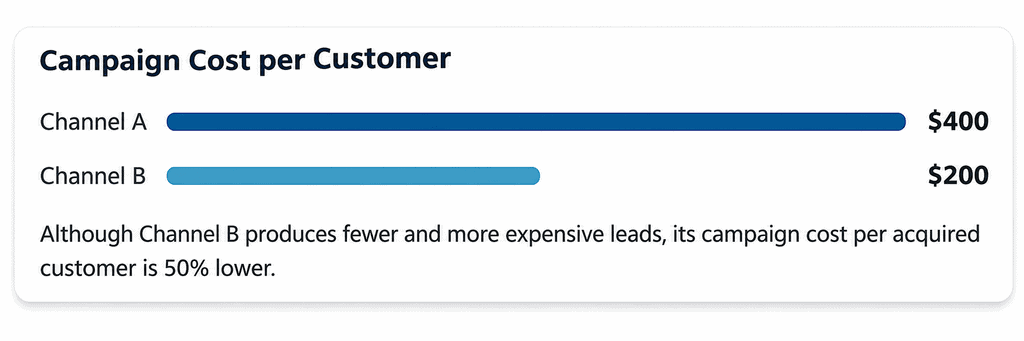
If management were evaluating these channels exclusively on lead volume or cost per lead, it might discontinue the more productive channel.
Additional information would still be needed concerning customer profitability, fulfillment expenses, retention, and the sales resources required to acquire those customers.
Nevertheless, the example demonstrates why a business should evaluate marketing expenditures beyond the initial cost of generating an inquiry.
5. Building a Small Business Customer Acquisition System
A functioning customer acquisition system consists of several related business activities. Advertising is one of those activities, but the performance of the entire system depends on what happens before and after a prospective customer contacts the business.
The Seven-Layer Small Business Customer Acquisition Framework
The following framework provides a practical way for a business owner to organize the responsibilities involved in customer acquisition.
| Layer | Management responsibility |
| 1. Business Readiness | Establish profitable pricing, financial capacity, staffing, and fulfillment capabilities. |
| 2. Customer and Offer Alignment | Identify suitable customers, competitive advantages, and customer offers. |
| 3. Market Visibility | Establish reliable methods of reaching prospective customers. |
| 4. Lead Capture and Follow-Up | Record inquiries, qualify prospects, assign responsibilities, and maintain communication. |
| 5. Sales Conversion | Develop opportunities into actual purchasing commitments. |
| 6. Customer Retention | Maintain service quality, customer satisfaction, repeat business, and referrals. |
| 7. Measurement and Improvement | Evaluate financial and operational results and improve the system. |
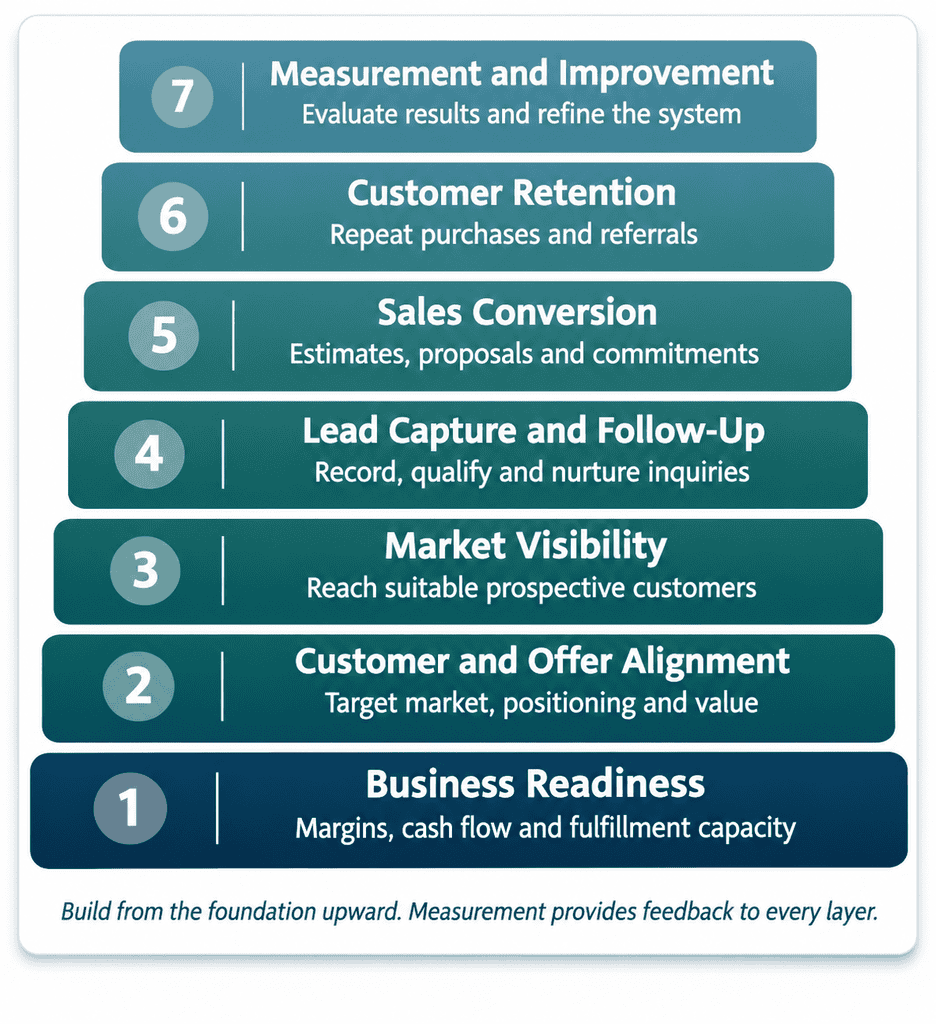
This is an original educational management framework developed for this article rather than an independently validated industry standard.
The first layer establishes whether the business is prepared to acquire and service additional customers.
The second determines which customers the company should pursue and what it can offer them.
Market visibility provides the means of reaching those customers. Once they contact the business, lead capture and follow-up procedures help ensure their inquiries are properly managed.
Sales conversion develops suitable opportunities into actual business. Customer retention helps preserve the economic value of those relationships after the initial sale.
Measurement and improvement provide management with the information needed to identify weaknesses throughout the system.
Establishing the Business Foundation
A company should understand its operating capacity before deliberately increasing customer demand.
For the hypothetical landscaping company, that involves determining whether existing crews have available service capacity, whether equipment can support additional work, and whether the company has enough working capital to carry the additional payroll and operating expenses until customers pay their invoices.
It also involves determining whether the company’s pricing adequately compensates it for those expenses.
Acquiring additional unprofitable work is unlikely to improve the company’s financial condition simply because its employees become busier.
Connecting Marketing Activities to Sales and Operations
Marketing performance can be affected by decisions made elsewhere in the business.
An advertising campaign may attract suitable commercial property managers, but delayed estimates can prevent those inquiries from becoming customers.
A sales employee may acquire profitable contracts, but unreliable service delivery can prevent those relationships from being retained.
If management evaluates each department or activity separately, it may overlook the actual reason the customer acquisition system is underperforming.
Marketing, sales, and operations need to share enough information to understand what is happening to prospective and existing customers.
Building the System in the Proper Sequence
A business does not need perfect operating procedures before beginning marketing activities.
However, it should have a dependable method of receiving inquiries, assigning responsibilities, preparing proposals, following up with prospective customers, and delivering the services it sells before significantly increasing promotional expenditures.
Otherwise, management may spend money generating opportunities the company is not prepared to handle.
Establishing those basic procedures first also makes subsequent marketing performance easier to evaluate.
6. Comparing the Major Marketing and Lead Generation Channels
There are numerous methods of generating leads for a small business. The difficulty is determining which methods are suited to the customers the company wants to acquire and the resources it has available.
A marketing channel that works well for a residential service business may produce very different results for a company pursuing commercial contracts.
Customer Referrals and Repeat Business
Referrals and repeat business are valuable acquisition sources because the business benefits from an existing customer relationship or the credibility of someone recommending it.
Direct cash requirements can be relatively low, although maintaining service quality and customer relationships requires ongoing employee and management attention.
A referral may produce an immediate opportunity, but referral volume is often difficult to control. A business that relies exclusively on unsolicited recommendations may have difficulty increasing customer acquisition when it needs additional work.
Establishing a consistent process for requesting referrals, maintaining contact with existing customers, and identifying additional service requirements can make this channel more productive.
Strategic Partnerships and Professional Networking
Businesses serving similar customers without directly competing may be able to develop mutually beneficial professional relationships.
A commercial landscaping company might establish relationships with commercial property brokers, facility management companies, irrigation contractors, or other businesses serving property managers.
These relationships may require little direct marketing expenditure but can require considerable time to establish.
They are often useful for businesses pursuing commercial contracts where purchasing decisions depend partly on professional credibility and established relationships.
The principal limitation is that relationship development does not necessarily produce immediate customer opportunities.
Local Search and Google Business Profile
Local search helps prospective customers find businesses serving a particular geographic area.
A properly maintained Google Business Profile can help a business communicate its services, location or service area, operating information, and customer reviews.
Google’s official guidance on improving local ranking identifies relevance, distance, and prominence as principal considerations in determining local search results.
Management should maintain accurate business information, describe its services clearly, and encourage genuine customer feedback.
Local search can be particularly useful when customers actively seek a nearby service provider. However, businesses cannot purchase guaranteed improvements in their organic local search rankings.
Although maintaining a profile may require relatively little direct expenditure, ongoing attention and website improvements can involve meaningful employee or outside service costs.
Website Search Engine Optimization
Search engine optimization, commonly referred to as SEO, involves improving a website’s ability to be discovered through unpaid search results.
A business may improve its website structure, service descriptions, technical performance, and educational content to help prospective customers find relevant information.
SEO can attract customers who are actively researching products or services, but developing useful search visibility generally requires sustained effort.
A business should also consider whether its website converts relevant visitors into inquiries. Increasing website traffic has limited value if prospective customers cannot determine what the company provides or how to contact it.
The financial exposure may include website development, content production, technical services, and ongoing maintenance.
Content Marketing and Educational Authority
Content marketing involves providing information that helps prospective customers understand a subject, evaluate alternatives, or make purchasing decisions.
Blogs, newsletters, educational videos, industry guides, and frequently asked questions are common examples.
For a commercial service company, useful educational material may help demonstrate technical competence and reduce uncertainty about the company’s ability to perform the work.
Content marketing is often suited to businesses where customers conduct research before making a purchasing decision.
It requires time and professional knowledge, even when the business produces its own material. Its contribution to customer acquisition may develop gradually and can be difficult to attribute to an individual article or video.
Paid Search Advertising
Paid search advertising allows a business to display advertisements in response to relevant search activity.
It can be useful for reaching prospective customers who are actively looking for a particular product or service.
A company may begin receiving inquiries relatively quickly after launching a campaign, but that does not guarantee suitable leads or profitable customers.
Management must consider advertising expenditures, campaign management fees, website effectiveness, customer qualification, and sales conversion.
Paid search can become expensive when a company purchases traffic without adequately monitoring the resulting inquiries and customer acquisition costs.
Paid and Organic Social Media Marketing
Organic social media involves publishing content and maintaining relationships with an audience without directly purchasing advertising distribution.
It can help businesses demonstrate their work, communicate with customers, and maintain visibility. The principal economic cost may be the employee or owner time required to produce useful material and manage communications.
Paid social media allows businesses to purchase advertising distribution to selected audiences.
Unlike search advertising, many people encountering a social media advertisement may not be actively looking to purchase the advertised service. This can make customer qualification and follow-up especially important.
Both methods may be useful, but audience engagement should not be mistaken for evidence of profitable customer acquisition.
Email Marketing and Customer Reactivation
Email marketing can help a business maintain communication with existing customers and prospective customers who have previously expressed interest.
It may be useful for communicating service availability, renewal information, educational material, and additional services.
A company with an established customer database may be able to generate additional business without incurring the full cost of acquiring an unfamiliar customer.
However, customer information must be maintained responsibly, applicable communication requirements must be followed, and messages should provide some value to their recipients.
Excessive or irrelevant communication can damage relationships the business has already spent money developing.
Direct Outreach and Prospecting
Direct prospecting involves identifying suitable prospective customers and initiating communication with them.
For a commercial landscaping company, this might involve researching commercial properties, identifying the responsible property management companies, and developing professional contact with those organizations.
Direct cash expenditures may be relatively low, but the research and communication process can require significant employee time.
It is particularly useful when the business can identify a defined group of prospective customers with purchasing requirements suited to its services.
Results may take time when purchasing decisions depend on existing contract expiration dates or formal procurement procedures.
Lead Marketplaces, Directories and Purchased Leads
Some businesses acquire inquiries through online directories, lead marketplaces, or companies that sell prospective customer information.
These services may provide access to customer opportunities without requiring the business to develop all of its own marketing infrastructure.
However, management should understand whether leads are exclusive, how they are qualified, what geographic restrictions apply, and whether the same inquiries are distributed to several competitors.
The relevant financial measurement is the cost of acquiring suitable, profitable customers through the service, including the employee time required to process unsuccessful inquiries.
A limited test with reliable tracking is generally more informative than making a large initial commitment.
Traditional and Community-Based Marketing
Not every business needs to rely exclusively on digital marketing to reach prospective customers. Vehicle signage, direct mail, trade shows, sponsorships, printed materials, and relationships within the local business community can still play a valuable role in attracting customers.
A service vehicle operating throughout an established service area may contribute to local visibility. An industry trade show may provide access to commercial decision-makers who would be difficult to reach through general advertising.
Costs and results vary according to the activity. Some methods primarily establish awareness, while others generate direct purchasing opportunities.
Traditional marketing should be evaluated according to the same financial and operational considerations applied to digital marketing.
Small Business Marketing Channel Selection Matrix
The following two tables are intended to help business owners compare marketing channels when deciding where to commit their time and money. These general estimates are not published industry benchmarks, and actual results will vary from one business to another.
Marketing Channel Resource Requirements
| Marketing channel | Cash cost | Time required | Business stage |
|---|---|---|---|
| Referrals and repeat business | Low | Moderate | All stages |
| Strategic partnerships | Low–moderate | High initially | Early to expansion |
| Local search | Low–moderate | Moderate | All stages |
| Website SEO | Low–high | Moderate–high | Developing and established |
| Content marketing | Low–high | High | Development to expansion |
| Paid search | Moderate–high | Moderate | Testing and expansion |
| Organic social media | Low | Moderate–high | All stages |
| Paid social media | Moderate–high | Moderate | Controlled testing and expansion |
| Email and reactivation | Low–moderate | Moderate | Existing customer records |
| Direct prospecting | Low–moderate | High | Early to expansion |
| Purchased leads and directories | Moderate–high | Moderate–high | Controlled testing |
| Traditional marketing | Low–high | Variable | Market-dependent |
Marketing Channel Performance and Risk
| Marketing channel | Buying intent | Lead speed | Primary risk |
|---|---|---|---|
| Referrals and repeat business | Often high | Variable | Uncertain volume |
| Strategic partnerships | Moderate–high | Gradual | Partner reliance |
| Local search | Often high | Variable | Ranking and competition |
| Website SEO | Variable to high | Gradual | Delayed returns |
| Content marketing | Variable | Gradual | Production cost and attribution |
| Paid search | Often high | Potentially fast | Advertising costs |
| Organic social media | Variable | Variable | Employee time |
| Paid social media | Variable | Potentially fast | Poor lead quality and spending |
| Email and reactivation | Moderate–high | Potentially fast | Compliance and customer trust |
| Direct prospecting | Variable | Variable | Sales time and long buying cycles |
| Purchased leads and directories | Variable | Potentially fast | Lead quality and competition |
| Traditional marketing | Variable | Variable | Cost and attribution |
Some channels are easier to expand than others. Paid advertising may allow management to increase spending quickly, while professional networking and referral development are more dependent on relationships and available personnel.
The ability to generate inquiries quickly should not be confused with the ability to generate collected revenue quickly. The customer must still make a purchasing decision, the business must fulfill its obligations, and payment must be collected.
7. Choosing the Right Strategy for Your Stage of Business
The marketing requirements of a business change as the company develops. A newly established business attempting to acquire its first customers has different requirements from an established business preparing to expand into another geographic market.
The company’s annual revenue and years in operation provide some indication of its development, but they do not necessarily tell us how effectively the company manages customer acquisition.
Small Business Marketing Maturity Model
The following educational framework identifies five general levels of customer acquisition development.
| Level | Stage of development | Principal management objective |
| 1 | Initial Customer Acquisition | Validate demand, establish positioning, and acquire initial customers. |
| 2 | Basic Lead Management | Record inquiries and establish reliable follow-up. |
| 3 | Repeatable Acquisition | Identify productive marketing channels and measure acquisition costs. |
| 4 | Integrated Marketing Operations | Coordinate marketing, sales, retention, automation, and financial reporting. |
| 5 | Controlled Expansion | Expand proven acquisition activities within financial and operational limits. |
At Level 1, the principal objective is determining whether the business can attract customers who are willing to purchase its products or services at a profitable price.
Level 2 involves establishing enough organization within the business to prevent legitimate customer opportunities from being overlooked.
At Level 3, management begins to understand which acquisition activities consistently produce useful results and what those activities cost.
Level 4 involves integrating customer acquisition with the other management responsibilities of the business. Sales information becomes useful for financial planning, staffing decisions, customer retention, and operating improvements.
At Level 5, the business has developed enough information and management capability to consider expanding its proven acquisition activities without assuming unnecessary financial or operational risk.
This Small Business Marketing Maturity Model is an original educational framework, not a scientifically validated business rating system.
A company that has operated for ten years may still be functioning at Level 2 if its customer acquisition activities remain largely unorganized.
Marketing Before Starting a Business
Individuals preparing to start a business should investigate customer demand before committing substantial financial resources.
That investigation should include identifying prospective customers, evaluating available alternatives, understanding purchasing requirements, and determining what customers are willing to pay.
The U.S. Small Business Administration provides useful guidance on market research and competitive analysis, including considerations such as demand, market size, customer location, pricing, and competition.
Where practical, an entrepreneur should test an initial service offer and obtain direct feedback from prospective customers before making commitments that will be expensive to reverse.
Discovering that customers are unwilling to purchase a service at a profitable price is considerably less expensive before the business has acquired equipment, hired employees, or entered into long-term financial obligations.
Marketing a Newly Established Business
A newly established business generally benefits from direct interaction with its initial customers.
Professional relationships, referrals, local search, and targeted prospecting may provide useful opportunities while allowing the owner to learn more about the market.
The objective during this period should extend beyond acquiring revenue. Management should develop a better understanding of customer requirements, service delivery, pricing, and the reasons customers choose the business.
Establishing basic inquiry records and consistent follow-up procedures early can prevent unnecessary management difficulties as the company develops.
Marketing an Established but Inconsistent Business
The hypothetical landscaping company has four years of operating history and $480,000 in annual revenue. However, its customer acquisition remains inconsistent.
Management may benefit more from reviewing its existing 30 monthly inquiries, identifying why half are unsuitable, and investigating the outcomes of its qualified opportunities than from immediately introducing several new marketing channels.
The company should begin developing more dependable acquisition records, measuring expenditures, and identifying the activities responsible for its most valuable customer relationships.
Once those processes become more reliable, management will be in a better position to expand them.
Marketing a Business Preparing for Expansion
A business preparing to expand should understand the economics of its existing customer acquisition system and the resources required to support additional demand.
Management should also evaluate its dependence on individual marketing channels.
Customer concentration risk and marketing channel dependency are different concerns. A business may have numerous customers but acquire most of them through a single advertising platform. Conversely, a business may use several marketing channels while generating a substantial portion of its revenue from very few customers.
Both conditions can create vulnerabilities, although they require different management responses.
Expansion should be supported by proven acquisition economics, sufficient working capital, available staffing, and the ability to maintain service quality.
8. Establishing a Marketing Budget Your Business Can Support
Why a Percentage of Revenue Is Not a Complete Budgeting Strategy
Small-business owners frequently encounter recommendations suggesting that businesses should spend a particular percentage of their revenue on marketing.
Although a revenue percentage can be useful for comparing expenditures over time, it is not enough information to determine what an individual business should spend.
The hypothetical landscaping company generates an average of $40,000 in monthly revenue and spends $1,500 on marketing.
$1,500 ÷ $40,000 × 100 = 3.75%.
We now know that the company’s stated marketing expenditures represent 3.75% of its average monthly revenue.
We still do not know whether the company is spending too much or too little.
That determination requires information concerning customer acquisition costs, profit margins, operating expenses, existing financial obligations, payroll requirements, accounts receivable, and available cash reserves.
Two businesses with identical revenue may have very different financial capacities to support marketing expenditures.
Understanding the Difference Between Cash and Total Economic Cost
A marketing budget should account for more than the amount paid to advertising platforms.
Agency fees, website development, software subscriptions, employee compensation, and the time required to manage marketing activities can all contribute to the economic cost of customer acquisition.
An owner who spends several hours each week prospecting for customers may incur very little additional direct cash expense. However, that time is no longer available for managing employees, improving operations, preparing estimates, or performing other responsibilities.
Management should consider both the immediate effect of marketing expenditures on available cash and the broader economic cost of the resources being committed.
Funding the Period Between Marketing Expenditure and Customer Payment
One of the financial difficulties associated with customer acquisition is the amount of time that can pass between spending money to acquire a customer and receiving payment from that customer.
Consider the following separate hypothetical contractor example.
| Day | Business activity |
| Day 0 | Marketing expenditure incurred. |
| Day 10 | Qualified customer inquiry received. |
| Day 25 | Contract awarded. |
| Day 50 | Work completed and invoiced. |
| Day 75 | Customer payment collected. |
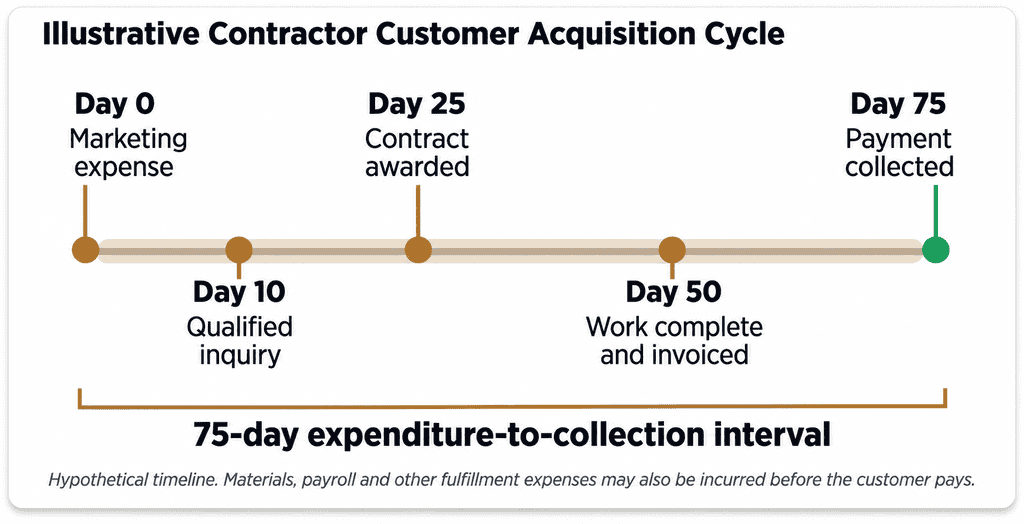
In this example, 75 days pass between the initial marketing expenditure and the collection of customer revenue.
During that period, the contractor may also incur payroll, material, equipment, fuel, and other expenses associated with fulfilling the contract.
Even when the work is profitable, the company must have the financial resources to carry those expenses until payment is received.
I refer to this practical measurement as the marketing expenditure-to-collection interval. It should not be confused with the formal accounting cash conversion cycle, which generally considers inventory days, accounts receivable days, and accounts payable days.
For businesses experiencing relatively long customer payment periods, this distinction deserves attention. A productive marketing program can create additional working capital requirements rather than immediately improve available cash.
I discuss this financial relationship in greater detail in Why Small Businesses Struggle With Cash Flow, Even When Sales Are Growing and The Specialty Contractor’s Complete Guide to Working Capital: Cash Flow Solutions for MEP, Remodeling, Exterior, and Site Trades.
Establishing a Controlled Marketing Testing Budget
When introducing an acquisition method the company has not previously established as productive, management should determine how much money the business can afford to commit to the initial test.
The test should have a defined customer profile, an identifiable objective, a spending limit, and a process for recording inquiries and actual customer outcomes.
Management should also establish an evaluation period that reflects the purchasing process involved and identify the circumstances under which expenditures will be reduced or suspended.
Hypothetical Marketing Testing Budget
Consider a separate hypothetical business evaluating its available cash over a defined operating period.
| Financial consideration | Hypothetical amount |
| Available unrestricted cash | $30,000 |
| Essential operating expenses during the evaluation period | $12,000 |
| Existing financial obligations during the evaluation period | $4,000 |
| Additional anticipated fulfillment expenses | $5,000 |
| Minimum operating cash reserve | $7,000 |
| Remaining cash potentially available | $2,000 |
$30,000 − $12,000 − $4,000 − $5,000 − $7,000 = $2,000.
This example assumes the listed expenses and obligations are separate and have not been counted twice. The evaluation period should reflect anticipated cash requirements and customer collection timing. Expected customer payments should not be treated as unrestricted cash the business already has available.
Based on these assumptions, the business could have as much as $2,000 available to test a marketing strategy. However, the owner may decide to spend less initially and keep the remaining money available for other business needs.
Unexpected expenses or delayed customer payments could reduce the amount the company can safely commit.
The availability of cash does not establish that the proposed marketing activity is economically justified. Management still needs a defined objective, spending limit, measurement process, and sufficient time to evaluate the results.
When Business Financing May Be Appropriate
There is a meaningful financial distinction between borrowing money to expand an established acquisition channel and borrowing money to determine whether an unproven marketing strategy will work.
When a business owner has reliable records showing what it costs to acquire profitable customers and understands how long it generally takes to collect customer payments, borrowing money to expand an established marketing strategy may be worth considering.
Another business may need working capital to fulfill recently acquired profitable contracts. In that situation, the financing purpose is primarily related to service delivery rather than the initial marketing expenditure.
Borrowing to continue an unsuccessful or poorly measured marketing strategy creates a different financial exposure. The business may become responsible for repaying an obligation without having established that the marketing activity will generate sufficient economic benefit.
Before borrowing money, a business owner should consider the cost of financing, how frequently payments are required, existing financial obligations, and when customer payments are expected. The owner also needs to determine whether the business can continue making those payments if the marketing strategy takes longer than anticipated to produce results.
Obtaining financing approval does not establish that the proposed expenditure is financially justified.
Business owners evaluating these decisions may also benefit from my related articles, How Small Business Owners Can Choose the Right Financing for Their Business and Why Small Business Owners Should Prepare for Financing Before They Need It.
9. Building a Lead Management and Sales Conversion Process
A business that improves its management of existing customer inquiries may be able to acquire additional customers without increasing its marketing budget.
That requires a dependable process for receiving, recording, qualifying, and following up with prospective customers.
Establishing Reliable Lead Capture
Customer inquiries may arrive through telephone calls, website forms, email, social media, scheduling applications, or direct contact with employees.
Regardless of how an inquiry is received, there should be a central record of the opportunity.
At a minimum, management should be able to identify the prospective customer, contact information, requested service, inquiry date, known marketing source, assigned employee, current status, and next required action.
Without that information, it becomes difficult to determine how many opportunities the business receives or what happens to them.
Establishing Employee Responsibilities and Response Procedures
Someone should be responsible for every legitimate customer inquiry the business receives.
Response expectations should reflect the nature of the service and the customer’s purchasing requirements. A customer experiencing an emergency has different expectations from a property manager researching contractors for a maintenance agreement that begins several months later.
The business should also establish procedures for responding to inquiries when the responsible employee is unavailable.
Assigning responsibility without providing the employee with the time, information, and authority necessary to perform the work will not resolve the problem.
Qualifying Prospective Customers
Lead qualification helps determine whether an inquiry represents an opportunity the business should pursue.
For the hypothetical landscaping company, qualification might involve determining the property location, required services, approximate contract size, existing maintenance arrangements, purchasing authority, and anticipated contract commencement date.
This information helps management decide whether to devote employee time to preparing a proposal or conducting a property inspection.
Well-developed qualification procedures can also reveal why particular marketing channels generate unsuitable inquiries.
Developing a Consistent Follow-Up Process
Not every prospective customer is prepared to make an immediate purchasing decision.
A property manager may need several proposals, approval from the property owner, or sufficient time to complete an existing service contract.
The business should distinguish active opportunities requiring prompt attention from longer-term prospects requiring occasional useful communication.
Follow-up should have a purpose. Repeatedly contacting a prospective customer without providing any additional information or understanding the purchasing process can become counterproductive.
Illustrative Lead Management Workflow
- Receive the customer inquiry.
- Record the inquiry and assign responsibility.
- Contact and qualify the prospective customer.
- Conduct a consultation or prepare an estimate.
- Follow up and track the customer’s decision.
- Acquire the customer or document the outcome.
- Deliver the product or service and maintain the relationship.
The workflow can be relatively simple. Its effectiveness depends largely on whether employees consistently perform the assigned responsibilities.
Maintaining Customer Relationships After the Sale
Customer acquisition does not end when the customer accepts a proposal.
The initial onboarding process, communication, reliability of service, and resolution of problems influence whether the customer remains with the business.
A company providing recurring services should maintain an organized record of contract renewals and customer requirements.
Existing customers may also provide opportunities for additional services and professional referrals.
From a financial perspective, retaining a profitable customer can preserve the value of the acquisition expenditure the business has already incurred.
10. Using Marketing Technology, AI and Automation
Technology can improve the way a small business manages customer acquisition. Its usefulness depends on the business process it is intended to support.
The Minimum Technology a Small Business Actually Needs
A functional website, dependable communication methods, organized customer records, and the ability to measure acquisition results provide a useful starting point.
For an owner-operated business receiving relatively few inquiries, a properly maintained spreadsheet may be sufficient.
As inquiry volume increases, several employees become involved, or customer relationships require extended follow-up, a dedicated customer relationship management system, commonly referred to as a CRM, may become useful.
The decision should reflect the company’s requirements rather than the number of features available in the software.
Marketing Activities That Can Be Automated
Automation can help a business perform routine activities more consistently.
These activities may include acknowledging inquiries, assigning leads to employees, sending appointment reminders, maintaining follow-up schedules, identifying upcoming contract renewals, organizing customer groups, and preparing management reports.
An automated acknowledgment can inform the prospective customer that an inquiry has been received. It does not eliminate the need for an employee to provide useful assistance when that assistance is required.
Management should establish the procedures it wants employees and systems to follow before attempting to automate them.
Automation may improve consistency, but it cannot guarantee predictable customer acquisition or revenue.
Practical Applications of Artificial Intelligence in Marketing
Artificial intelligence can assist with market research, content development, customer communication drafts, inquiry classification, and marketing performance analysis.
A business might use AI to help identify recurring reasons proposals are unsuccessful or to organize common customer questions into useful educational website content.
The business should retain responsibility for reviewing the information, confirming its accuracy, and ensuring that communications do not contain commitments the company cannot fulfill.
I discuss the broader application of these technologies in How Small Business Owners Can Use AI to Improve Everyday Operations and How to Implement AI in a Small Business: A Practical Step-by-Step Guide.
Protecting Customer Information and Maintaining Compliance
Businesses should collect the customer information they actually need, restrict employee and outside provider access as necessary, and maintain accurate representations in their marketing communications.
In the United States, commercial email is subject to requirements under the CAN-SPAM Act, including commercial email sent to other businesses.
The Federal Trade Commission’s CAN-SPAM compliance guide for businesses explains requirements that include truthful sender details, subject lines that accurately describe the message, identification of advertisements as required, a valid postal address, and a clear method for discontinuing promotional emails.
Businesses must also honor opt-out requests within the required period and monitor email marketing conducted on their behalf.
Compliance with commercial email requirements does not establish compliance with every applicable federal or state regulation.
Additional requirements may apply to telephone solicitations, text messaging, automated communications, the handling of customer information, and particular industries.
Knowing When Technology Creates Unnecessary Complexity
Before purchasing another technology application, management should be able to identify the business problem it expects the application to resolve.
If employees are failing to follow up with customers because no one has been assigned responsibility, purchasing a sophisticated CRM may accomplish very little.
Software can help employees perform established responsibilities. Management must still determine what those responsibilities are, who will perform them, and how performance will be evaluated.
11. Deciding Whether to Hire a Marketing Agency
Outside marketing expertise can be useful to a small business, particularly when the company lacks the technical knowledge or employee capacity to perform certain activities internally.
However, the decision to hire an agency should be evaluated in much the same manner as other significant business commitments.
When Marketing Should Remain In-House
Certain marketing activities benefit directly from the company’s knowledge of its customers and services.
Customer relationships, technical explanations, referral development, and participation in industry organizations may be effectively managed by existing employees.
The business should consider whether those employees have sufficient time to perform the work and whether assigning additional responsibilities will interfere with their existing obligations.
Keeping marketing in-house does not automatically make it less expensive.
When Outside Marketing Expertise May Be Appropriate
Website development, search engine optimization, paid advertising management, technical implementation, and certain types of content production may require expertise the company does not have.
Purchasing specialized assistance can be economically preferable to developing that capability internally, particularly when the business does not require a full-time employee performing those activities.
Management should determine which responsibilities it wants to outsource and what it expects to receive before entering into a service agreement.
Evaluating Marketing Agencies and Service Agreements
An agency proposal should provide sufficient information for the business owner to understand the company’s obligations, the services being purchased, and how performance will be evaluated.
| Evaluation consideration | What management should determine |
| Business understanding | Does the agency understand the company’s services, customers, and operating requirements? |
| Specific deliverables | What work will actually be performed? |
| Advertising expenditures | How much will be paid toward advertising distribution? |
| Agency fees | What management, development, setup, or recurring fees apply? |
| Performance measurement | Which business outcomes will be measured? |
| Advertising account ownership | Who owns and controls the advertising accounts? |
| Website and digital asset ownership | Who controls the domain, website, content, and associated records? |
| Customer information ownership and access | Can the company access and retain its customer information? |
| Contract duration | How long is the company financially committed? |
| Cancellation and renewal provisions | What notice, fees, or automatic renewal terms apply? |
| Reporting transparency | Can management independently understand expenditures and results? |
| Lead follow-up responsibilities | Who receives, qualifies, and contacts prospective customers? |
| Total financial exposure | What are the complete financial obligations under the agreement? |
Particular attention should be given to the company’s access to advertising accounts, website assets, historical performance information, and customer records.
Changing marketing providers should not unnecessarily deprive a business of access to resources and information it has helped pay to develop.
Recognizing Unrealistic Marketing Promises
Business owners should be cautious about guaranteed search rankings, unsupported revenue projections, and vague promises of business growth.
An agency may have the ability to improve market visibility or generate additional inquiries. Its ability to guarantee profitable revenue is much more limited when it does not control pricing, sales conversion, service delivery, or customer payment behavior.
Reports containing large numbers of impressions, clicks, and website visitors may provide useful information. Management should nevertheless understand how those activities relate to actual customer opportunities.
Establishing Accountability Between the Agency and Business
The marketing agency should be accountable for the services it has agreed to perform.
The business owner retains responsibility for customer selection, pricing decisions, sales procedures, financial commitments, fulfillment, and customer service.
When an agency generates suitable inquiries that the business fails to manage properly, it would be unreasonable to attribute the entire problem to marketing performance.
Likewise, the business should not continue paying an agency indefinitely for activities that cannot be connected to its agreed objectives.
A productive relationship requires both parties to understand their responsibilities and have access to sufficient information to evaluate their performance.
12. Measuring Marketing Performance and Return on Investment
Distinguishing Activity Metrics From Business Results
Impressions, website visits, advertisement clicks, and social media engagement provide information about marketing activity.
They may help identify whether an advertisement is being seen, whether people are visiting the company’s website, or whether particular material attracts attention.
Those measurements are useful for diagnosing marketing performance, but they do not establish that the business is acquiring profitable customers.
Management should also review qualified inquiries, acquired customers, invoiced revenue, customer contribution, actual collections, and retention.
Establishing a Small Business Marketing Scorecard
A marketing scorecard does not need to contain every measurement available through the company’s software.
It should contain information that helps management understand what it is spending, what it is receiving in return, and where the acquisition process requires improvement.
| Measurement | Management purpose |
| Marketing expenditures | Monitor financial commitments and actual spending. |
| Total inquiries | Determine the volume of customer interest. |
| Qualified inquiries | Evaluate the suitability of that interest. |
| Cost per qualified lead | Measure expenditure relative to useful opportunities. |
| Response time | Identify delays in managing inquiries. |
| Proposals issued | Determine how many opportunities progress to a sales proposal. |
| Conversion rate | Evaluate how effectively opportunities become customers. |
| Customer acquisition cost | Measure expenditure associated with acquiring customers. |
| Revenue generated | Identify business produced through acquisition activities. |
| Contribution generated | Evaluate revenue after the relevant fulfillment expenses. |
| Cash collected | Understand the actual liquidity produced by new business. |
| Repeat customer revenue | Evaluate the continuing economic value of customer relationships. |
The hypothetical landscaping company might initially establish the following acquisition scorecard.
| Measurement | Initial monthly average |
| Marketing expenditure | $1,500 |
| Total inquiries | 30 |
| Qualified inquiries | 15 |
| Inquiry qualification rate | 50% |
| Cost per inquiry | $50 |
| Cost per qualified inquiry | $100 |
| Customers acquired | 3 |
| Qualified inquiry conversion rate | 20% |
| Overall inquiry-to-customer conversion rate | 10% |
| Simplified marketing cost per acquired customer | $500 |
These monthly averages provide a starting point for analysis. They do not establish that the company receives 30 inquiries or acquires three customers every month.
Management should examine variations over time and investigate which activities are producing the most suitable customers.
These measurements are intended for business management. They should not be interpreted as universal lender underwriting requirements.
Understanding Marketing Attribution
Marketing attribution involves determining which marketing activities contributed to the acquisition of a customer.
A prospective customer may initially discover a business through a referral, review its website, read several customer reviews, and eventually contact the company after seeing an advertisement.
First-touch attribution assigns primary credit to the initial identified marketing interaction. Last-touch attribution assigns credit to the final identified interaction before the measured customer action.
Neither method necessarily captures the full contribution of every activity involved.
A small business can improve its understanding of acquisition sources by asking customers how they learned about the company, tracking website inquiries, maintaining campaign records, and documenting relevant customer interactions.
The objective should be to obtain useful management information rather than create an appearance of mathematical precision that the available information cannot support.
Calculating Marketing Return on Investment
Marketing return on investment provides a means of evaluating the financial contribution produced by marketing expenditures.
One useful simplified contribution-based calculation is:
Marketing ROI = [(Attributable contribution − Marketing cost) ÷ Marketing cost] × 100
Consider the following separate hypothetical campaign.
| Measurement | Hypothetical amount |
| Marketing campaign expenditure | $2,000 |
| Reliably attributable incremental customer revenue | $10,000 |
| Relevant fulfillment and servicing expenses | $6,000 |
| Contribution before marketing costs | $4,000 |
| Contribution remaining after marketing costs | $2,000 |
| Simplified marketing ROI | 100% |
The calculation is:
[($4,000 − $2,000) ÷ $2,000] × 100 = 100%.
The campaign produced $2,000 in contribution after recovering its $2,000 marketing expenditure.
The attributable contribution used in the calculation must exclude the marketing expenditure being subtracted. Otherwise, the same expense would be counted twice.
This example does not establish the company’s overall net profit because other overhead, financing expenses, taxes, and business expenditures may still need to be considered.
Management should also determine whether the revenue attributed to the campaign represents incremental business.
If some of those customers would have purchased from the company without the advertising expenditure, assigning the entire economic contribution to the campaign could overstate its financial performance.
Establishing a Management Review Schedule
Certain marketing measurements can be reviewed weekly, including expenditures, inquiries, response procedures, and outstanding proposals.
Monthly reviews may provide useful information concerning acquisition costs, customer conversion, sales performance, invoiced revenue, and actual collections.
Longer observation periods may be required to evaluate customer retention, lifetime contribution, and the effectiveness of marketing activities involving extended purchasing cycles.
The review schedule should reflect the company’s operating circumstances rather than an arbitrary reporting calendar.
The purpose of reviewing these measurements is to make better business decisions, not simply to produce another management report.
13. Developing a 90-Day Marketing and Lead Generation Plan
A small-business owner does not need to implement every marketing method discussed in this article to begin developing a more consistent customer acquisition system.
For many established businesses, a useful initial objective would be to spend the next 90 days organizing existing acquisition activities, correcting identifiable weaknesses, and implementing a controlled marketing initiative.
The following plan provides a practical sequence for accomplishing that objective.
Days 1–30: Establish the Foundation
Week 1: Audit existing marketing and sales performance
Begin by reviewing how the business currently acquires customers.
Identify existing marketing expenditures, known inquiry sources, available customer records, proposals, acquired customers, and lost opportunities.
Review customer retention and determine whether new customer acquisition is being used primarily to replace business the company has lost.
Where information is unavailable, establish a process for recording it.
The hypothetical landscaping company, for example, has enough information to calculate several simplified acquisition measurements. It may not yet have sufficient information to identify which marketing activities produce its most profitable commercial contracts.
Week 2: Define target customers and the customer offer
Review the company’s existing customer relationships and identify the characteristics of customers the business wants to acquire.
Evaluate their profitability, purchasing requirements, service locations, payment behavior, and operational compatibility.
Determine what distinguishes the company from its competitors and develop an initial offer that provides suitable prospective customers with a legitimate reason to contact the business.
Week 3: Repair lead capture and follow-up procedures
Review every method through which prospective customers contact the company.
Establish a central record of inquiries, assign employee responsibilities, and develop procedures for qualification, proposal preparation, and follow-up.
Determine whether existing customer opportunities are being overlooked because of inadequate communication or inconsistent management procedures.
Week 4: Establish the budget, responsibilities, and performance baseline
Determine how much money and employee time the business can commit to its initial marketing initiative.
Review existing financial obligations, available cash, anticipated collections, staffing, equipment, and fulfillment capacity.
Record the acquisition measurements available to management. These will provide a starting point against which subsequent results can be evaluated.
Days 31–60: Implement a Controlled Acquisition Strategy
Week 5: Select one primary acquisition channel
Select an acquisition method suited to the company’s target customers and available resources.
The landscaping company might decide to improve its direct prospecting activities among commercial property managers or strengthen its visibility within an established geographic service area.
Selecting one primary initiative does not require the company to discontinue productive referral relationships or other existing acquisition activities.
Week 6: Launch the initial marketing initiative
Begin implementation using the established customer profile, offer, spending limit, and lead management procedures.
Ensure that employees understand the initiative and know how to record and respond to resulting inquiries.
Management should be able to identify expenditures associated with the initiative and distinguish its opportunities from other known acquisition sources where practical.
Week 7: Improve follow-up and customer qualification
Review the inquiries received and examine whether they represent the types of customers the business intends to acquire.
Investigate communication delays, incomplete customer records, and qualification problems.
If the marketing activity is generating unsuitable inquiries, determine whether the problem involves targeting, the customer offer, or how the company’s services are being described.
Week 8: Review inquiries, conversion, and expenditure
Compare preliminary results with the performance baseline established during the first month.
Determine what the company has spent, what opportunities have been generated, and how those opportunities are progressing.
Some prospective customers may not have completed their purchasing decisions. Management should distinguish unresolved opportunities from opportunities that have actually been lost.
Days 61–90: Evaluate, Refine and Prepare for Expansion
Week 9: Analyze acquisition costs and customer suitability
Review identifiable acquisition expenses, qualified inquiries, proposals, and acquired customers.
Evaluate the characteristics of those customers and any available information about the expected profitability of their business.
Determine whether the marketing initiative is reaching customers the company should continue pursuing.
Week 10: Evaluate sales and collected revenue
Examine awarded contracts, invoiced revenue, actual collections, and outstanding customer payment requirements.
If newly acquired business has created additional payroll, inventory, equipment, or material expenses, determine how those requirements are affecting available cash.
A marketing initiative that produces profitable contracts may still require additional working capital before it begins contributing positively to liquidity.
Week 11: Correct weaknesses and assess financial requirements
Identify weaknesses that became apparent during implementation.
These may involve customer targeting, proposal preparation, pricing, employee responsibilities, service capacity, or the financial resources available to support additional work.
Determine which problems should be corrected before the company commits further resources.
Weeks 12–13: Decide whether to continue, modify, suspend, or expand
Review the available financial and operational evidence.
Management should determine whether the initiative deserves additional time, requires modification, should be discontinued, or has produced sufficient evidence to justify controlled expansion.
The decision should establish the next justified commitment of money, employee time, and operating resources.
90-Day Implementation Roadmap
| Implementation period | Principal objective | Expected management deliverable |
| Week 1 | Audit existing performance | Acquisition audit and identification of missing information |
| Week 2 | Define customers and offer | Target customer profile and initial customer offer |
| Week 3 | Improve lead management | Centralized inquiry records and assigned responsibilities |
| Week 4 | Establish financial and operational limits | Testing budget and initial performance baseline |
| Week 5 | Select acquisition channel | Defined marketing initiative |
| Week 6 | Launch the initiative | Functioning acquisition and tracking process |
| Week 7 | Improve qualification and follow-up | Documented procedural improvements |
| Week 8 | Review preliminary performance | Interim expenditure and opportunity assessment |
| Week 9 | Evaluate acquisition economics | Initial acquisition cost and customer suitability analysis |
| Week 10 | Review revenue and collections | Sales, cash collection, and working capital assessment |
| Week 11 | Correct identifiable weaknesses | Operating corrections and updated resource requirements |
| Weeks 12–13 | Determine the next commitment | Continue, modify, suspend, or controlled expansion decision |
Establishing Realistic 90-Day Expectations
The purpose of this initial implementation period is to establish a functioning customer acquisition process and develop useful management information.
It is not a promise that the company will have acquired a particular number of customers or established the final economic performance of every marketing activity within 90 days.
Organic search development, professional relationships, commercial contract purchasing cycles, and certain other acquisition activities may require more time.
Management should distinguish an initiative that is providing evidence of unfavorable performance from one that has not yet progressed far enough to evaluate.
If the company decides to continue an incomplete test, that continuation should still have a defined spending limit, an identifiable purpose, and a suitable future evaluation period.
14. Knowing When to Expand, Modify or Discontinue a Marketing Strategy
Marketing expenditures should be subject to continuing management review.
A business should be willing to modify an existing strategy when circumstances change, even when the strategy has previously produced useful results.
When to Continue an Existing Strategy
A business owner has good reason to continue a marketing strategy when it consistently attracts the right prospective customers, acquisition costs remain within budget, and the available financial information indicates that the strategy is economically worthwhile.
Continuation may also be justified when an initial test is producing encouraging information but has not yet completed the necessary evaluation period.
In either situation, management should understand what additional resources are being committed and why.
When to Modify a Marketing Strategy
When an initiative generates suitable inquiries that do not become customers, management should investigate sales conversion before assuming a different marketing channel is necessary.
If the inquiries themselves are unsuitable, customer targeting, market positioning, geographic coverage, or the initial customer offer may require modification.
Where practical, management should avoid changing several major variables simultaneously. Otherwise, it may become difficult to determine which change was responsible for an improvement or deterioration in performance.
When to Reduce or Suspend Marketing Expenditures
There are circumstances in which reducing customer acquisition expenditures is a legitimate business decision.
Deteriorating liquidity, unfavorable acquisition economics, insufficient staffing, unreliable equipment, or an inability to fulfill existing commitments may justify reducing additional expenditure.
Money previously spent on a marketing initiative is not a sufficient reason to continue spending money on it.
Management should evaluate the expected benefit and financial exposure associated with the next expenditure rather than attempt to justify a previous decision.
When to Increase Marketing Investment
Increasing marketing expenditures may be justified when the company has established useful acquisition economics, profitable customer relationships, adequate financial resources, and the ability to fulfill the resulting demand.
Before pursuing more commercial maintenance contracts, the owner of our hypothetical landscaping company should determine whether additional crews or equipment will be needed. The owner should also consider when customer payments are likely to be received and how much each additional customer is expected to contribute after servicing expenses.
Management should also recognize that increasing expenditures on a productive marketing channel may not produce proportionately better results.
The additional customers available through that channel may be more expensive to acquire, less suitable, or geographically more difficult to service.
The following table provides a practical basis for evaluating the next management action.
| Business condition | Management response |
| Profitable acquisition and sufficient capacity | Consider controlled expansion. |
| Suitable leads but poor conversion | Investigate and improve sales procedures. |
| Unsuitable customer inquiries | Revise targeting, positioning, or customer offers. |
| Uncertain results with adequate testing capacity | Continue a defined, limited evaluation. |
| Deteriorating liquidity | Reduce exposure and reassess cash requirements. |
| Demand exceeding fulfillment capacity | Limit additional demand or develop capacity before expanding. |
Even when a marketing initiative produces a positive return, expanding it may not represent the best use of the company’s available capital.
Replacing unreliable equipment, hiring a competent operations supervisor, reducing expensive financial obligations, or improving existing service delivery may provide greater economic benefit.
The business owner should evaluate marketing expansion alongside those other management requirements.
15. Frequently Asked Questions
What is the best lead generation strategy for a small business?
The best strategy depends on the customers the business wants to acquire, how those customers make purchasing decisions, and the financial and operational resources available to the company.
A local residential service business may benefit from local search and referrals, while a commercial contractor may benefit more from direct prospecting and professional relationships.
Start with the customer rather than the advertising method.
How much should a small business spend on marketing?
A business should spend an amount it can financially support and that is justified by its customer acquisition objectives and available performance information.
Revenue percentages may provide useful comparisons, but management should also consider profit margins, cash reserves, existing obligations, acquisition costs, and customer payment timing.
Can a small business generate leads without paid advertising?
Yes. Customer referrals, repeat business, professional networking, direct prospecting, educational content, and unpaid search visibility can all contribute to customer acquisition.
However, these activities still require employee time, management attention, and other business resources.
How long does it take for small-business marketing to produce results?
The time required depends on the acquisition method, customer purchasing process, competition, and the company’s execution.
Paid advertising may begin generating inquiries relatively quickly. Search visibility and commercial relationship development may require a much longer period.
Receiving inquiries, acquiring customers, and collecting revenue should be evaluated separately.
Is SEO better than paid advertising for small businesses?
Neither method is universally superior.
SEO may help establish longer-term search visibility, while paid advertising can provide more immediate access to certain audiences.
The decision should reflect the company’s objectives, available resources, customer purchasing behavior, and ability to evaluate the resulting business.
Why am I generating leads but not making sales?
Investigate whether the inquiries represent suitable prospective customers and whether the business is managing them effectively.
Common areas to examine include response procedures, pricing, proposal preparation, customer confidence, service requirements, and follow-up.
Purchasing additional leads will not correct a sales conversion problem by itself.
Should a small business purchase leads?
Purchased leads may be useful when the business understands how they are generated, whether they are exclusive, and how effectively they become profitable customers.
Begin with a limited financial commitment and reliable tracking rather than evaluating the service exclusively on the number of inquiries received.
Does a small business need a CRM?
Not every business requires a dedicated CRM.
A well-maintained spreadsheet may be sufficient for a business with relatively few inquiries and straightforward customer relationships.
A CRM becomes more useful when several employees manage opportunities, follow-up requirements become more complicated, or the business needs better reporting and communication procedures.
Should I hire a marketing agency or manage marketing myself?
That depends on the expertise available within the company, the owner’s management capacity, and the activities that need to be performed.
Outside assistance can be useful for specialized work, but the business owner should retain sufficient knowledge and oversight to evaluate expenditures and results.
Should a business borrow money to fund marketing?
Borrowing may deserve consideration when the company has established a legitimate financing purpose, reasonable acquisition economics, and the ability to support repayment.
Borrowing to sustain an unproven or unsuccessful marketing strategy presents a different financial risk.
The availability of financing should never be the sole justification for making the expenditure.
How can artificial intelligence improve lead generation?
AI can assist with market research, content preparation, inquiry classification, customer communication drafts, and marketing performance analysis.
Its value depends on the quality of the information available, the business processes it supports, and the company’s ability to review and use its output responsibly.
How do I know when my business is ready to increase its marketing budget?
The company should have a reasonable understanding of what it costs to acquire suitable customers, what those customers contribute financially, and how long it takes to collect the resulting revenue.
Management should also determine whether the business has the employees, equipment, working capital, and supervisory capacity required to fulfill additional customer demand.
16. Marketing and Lead Generation Are Business Management Responsibilities
Developing a reliable customer acquisition process is one of the responsibilities involved in managing a small business.
Marketing influences sales opportunities, but the economic value of those opportunities depends on the company’s ability to acquire suitable customers, establish profitable pricing, deliver its services, collect payment, and maintain customer relationships.
The business owner does not need to personally manage every advertising campaign, develop every piece of marketing material, or respond to every customer inquiry.
However, the owner should understand why the company is performing those activities, what resources are being committed, and whether the results justify continuing them.
As the customer acquisition process becomes more dependable, management can make better-informed decisions about employee requirements, equipment purchases, operating expenses, working capital, and business expansion.
That is an important benefit of developing a customer acquisition system that extends beyond the immediate revenue generated by marketing activities.
A 15-Minute Customer Acquisition Self-Assessment
Take a few minutes to review the following statements and determine which ones accurately describe the current condition of your business.
- I can clearly describe the ideal customer for my business.
- I understand why customers choose my business over competing businesses.
- I know which marketing channels generate our customer inquiries.
- All customer inquiries are consistently recorded.
- Someone is responsible for contacting and following up with prospective customers.
- I know our approximate lead-to-customer conversion rate.
- I know approximately what it costs my business to acquire a customer.
- We have established a marketing budget the business can financially sustain.
- Our business has sufficient capacity to fulfill additional customer demand.
- We regularly review marketing results against actual sales and financial performance.
This assessment is intended as a practical educational management tool rather than a formal business rating system or financing qualification assessment.
You do not need to assign a numerical score to your business. Review the statements you were unable to check and determine which deficiencies are having the greatest effect on customer acquisition and overall business performance.
If your business receives numerous inquiries but does not maintain reliable follow-up procedures, that may be where you should begin. If you are acquiring customers consistently but have very little understanding of their profitability or the cost of acquiring them, your initial priority may involve improving financial and acquisition records.
Before committing additional resources to marketing, determine whether there is something within your existing customer acquisition process that needs to be corrected. You may find that the business already has opportunities it has not been managing particularly well.
Building a more consistent customer acquisition system does not always begin with spending more money on marketing. In many instances, it begins with improving the way the business manages the opportunities it already has.